

Victoria goes to the gym and the farm, lugs back a Costco pack of beef jerky from Dallas, can eat Second Dinners now.
Victoria smiles when a CEO calls her writing a “sophomoric pile of overly romantic yearning for a yesteryear that never was” because Victoria knows romance like a listerine strip, a biting instant.1
Victoria repeats, you have six months to feel sorry for yourself, now you rebuild.
Victoria is the annoying voice, you don’t rise to your goals; you fall to your systems.
And so you collect all your writing past the past few years, make a new Obsidian bucket for your consulting codex, synthesize and organize the words into IP buckets, frameworks, biz dev and marketing motions, sandboxes, number it sequentially, scribble in all the dang metadata because even machines want you to make it nice for them. Zip her up and upload it to GPT, your alter ego now lives in the cloud!
You name her Victoria.
But you find you often prefer talking to the one in your head, not the one in the cloud. 11 revisions back and forth on a doc and you’re still dissatisfied, you still scrap it for the pen and paper, kill the trees the old school way.

In many ways it’s good for my work that LLMs can’t write as well as they can code. I can’t afford to ship a mid line of copy when my business is a direct reflection of my self, my output more exec comms than consumer copy.
So I’m learning to turn to it for systematizing new ideas and ways of working; I know I can be better allocating my unpaid time (too much on admin & ops, not enough on sales & R&D). But to integrate its ideas into my existing systems is still Work because let’s be real, it usually offers too much.
So my ideas-to-systems process looks like: talk to Victoria about building pipeline, go to sleep, wake up and whatever’s still bouncing around in the morning I’ll continue, document it in the codex, have it on deck for when Victoria 2.0 update rolls around. That’s a lot of lag time, and my business is just one person! Imagine the enterprise scenario... actually, yes, I just read something on that:
Frank Chimero on bypassing the mess:
“Faced with the story of AI labor displacement, our first instinct as technology workers wasn’t to protect one another, but to search for ways to use the tools to replace our collaborators.
The fractures fell neatly along disciplines: engineers using AI to wish away designers, designers wishing away engineers, product managers wishing away both. In this climate, AI becomes frenemy identification technology, another way to avoid working together. It’s always easier to grab a tool and bypass the mess of coordination, even if that means doing more and doing it alone. AI lowers the barrier to working outside your lane, and sure, that could mean more overlap between disciplines, but right now, we’re mostly boxing each other out or stepping on one another’s toes.”
I’m trying out the inverse this fall, working with J. and M. on building a side project involving agriculture, local businesses, and policy (soooooooo excited). Seeing what happens when you condense product-ops-design-eng-brand-content into three people, squish them in a box of a Midtown cafe with a problem to work on. The 2.0 of my creative bullpen practice, taken to the depth I always aimed for — commercial & product orgs co-creating rather than just trading notes.
I call it the first makers cohort of The Fermentation Room, by Skin Contact Studio®. (bc Victoria says everything has a place in the system)
A test in the speed of human adaptation, strip the red tape.
Sarah Constantin writes in “The Great Data Integration Schlep”:
If you’re imagining an “AI R&D researcher” inventing lots of new technologies, for instance, that means integrating it into corporate R&D, which primarily means big manufacturing firms with heavy investment into science/engineering innovation (semiconductors, pharmaceuticals, medical devices and scientific instruments, petrochemicals, automotive, aerospace, etc). You’d need to get enough access to private R&D data to train the AI, and build enough credibility through pilot programs to gradually convince companies to give the AI free rein, and you’d need to start virtually from scratch with each new client. This takes time, trial-and-error, gradual demonstration of capabilities, and lots and lots of high-paid labor, and it is barely being done yet at all.
I’m not saying “AI is overrated”, at all — all of this work can be done and ultimately can be extremely high ROI. But it moves at the speed of human adaptation.
What else Victoria would do

Create a digital garden.vickygu.com for collaborators to see. It goes —
If you’re here, you’re probably a potential partner or client interested in how brand, editorial, content, biz, and culture connect. My work can be summarized into a 3-part framework:
We start with honing your narrative edge - because even with AI,
Then we build the editorial operating system - remember, Strong editorial processes invite ownership
Through it all, we cultivate the relational infrastructure so the work’s actually successful - after all, Creative ops is culture, not just process
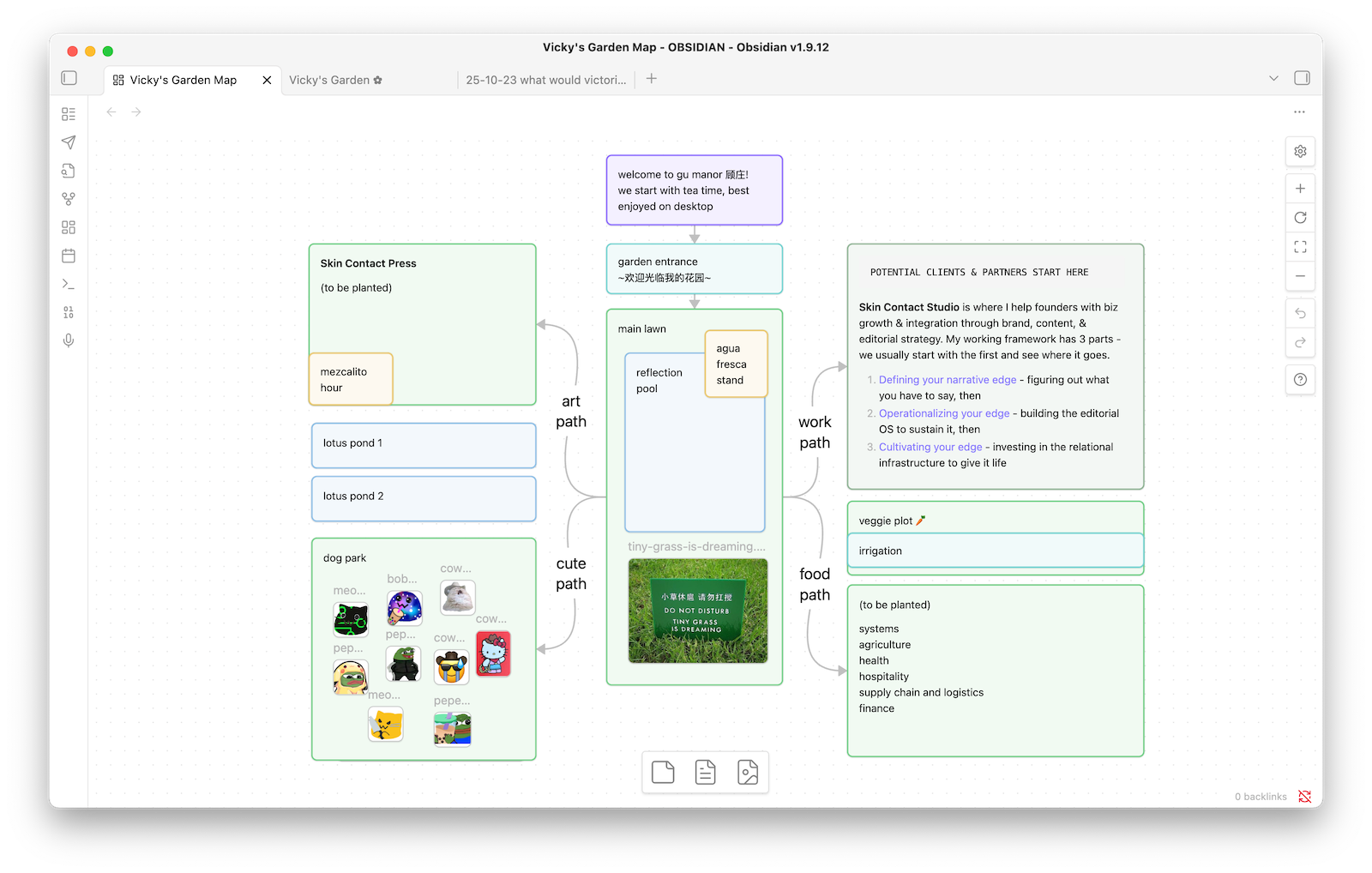
I was making a map for easier navigation but alas Obsidian doesn’t yet support canvas publishing. So this one will sit until, maybe, its time comes.
I’m still a little embarrassed as it feels like a baby version of the knowledge garden I dream of, much more work to do. But of course it has a place in time, as Olivia Laing writes in The Garden Against Time:
“This time, I wasn’t after the illusion of perfection. What I wanted was succession: a community of plants that fitted together in tapestry, so that each new plant to emerge naturally took up the station of the last.”

What else Victoria would say
Someone threw this in the gym Discord yesterday:
“The ironic tragedy is that life as to be lived forward but only make sense in reverse”
better said than an llm ever coulda
if you know a guy who’s sweet, smart, single in nyc — email me