


Quick admin note: Secret Granola Club members (paid supporters) - send me your address if it’s changed since November! I’m sending out new year cards in the next month.
It is always tempting to wonder - what if you were offered the golden handcuffs? The house by the water? The white man with the mild manners and strong credit score? Would you take them?
At the same time it seems they are irrelevant questions to burden your mind with; there are more urgent things like when will these shoes stop hurting me???
Incubating your own business is like breaking in a pair of Birkenstocks but you’re breaking in yourself and once you’re ready to hurl them (read: self) out the window, they finally mold to you, decide to carry you where you’re trying to go. At least for now.
My 2025 learning can be summed up as: Building a business is a practice of submission. (Like Kristen Stewart says of acting.) Throw as much logic, process, judgment, infrastructure at it as you want - then retreat and let the wind do the rest.
It turns out being independent restores much of the beauty and mystery and dignity to the work if you can swallow the volatility, heads up tastes like upchuck. You have to give every opportunity a fair shot meaning all your sincerity and enthusiasm all while knowing it might break because life is applied statistics - but what if it holds? (万一?)

What if the magic breaks the equation for once?
What if you surprise yourself with what you choose to carry, to drop?
but forgetting triumphed in the end,
forgetting, round as a ball,
sweet as a strawberry, final
as judgment.
—Adam Zagajewski, Grażyna
Below - some more detailed notes on sales & biz dev, consulting style, LLMs, support network. My learnings this year were less about the work, more about building the life to sustain the work. Share it with someone who needs it!
Show up to the basement, the backyard, the bar (On sales & biz dev)
2025 has also been a practice of listening, or more like - learning how to listen, how to metabolize your conversation partner’s intent, now quick! react with poise and purpose. You know, sales.
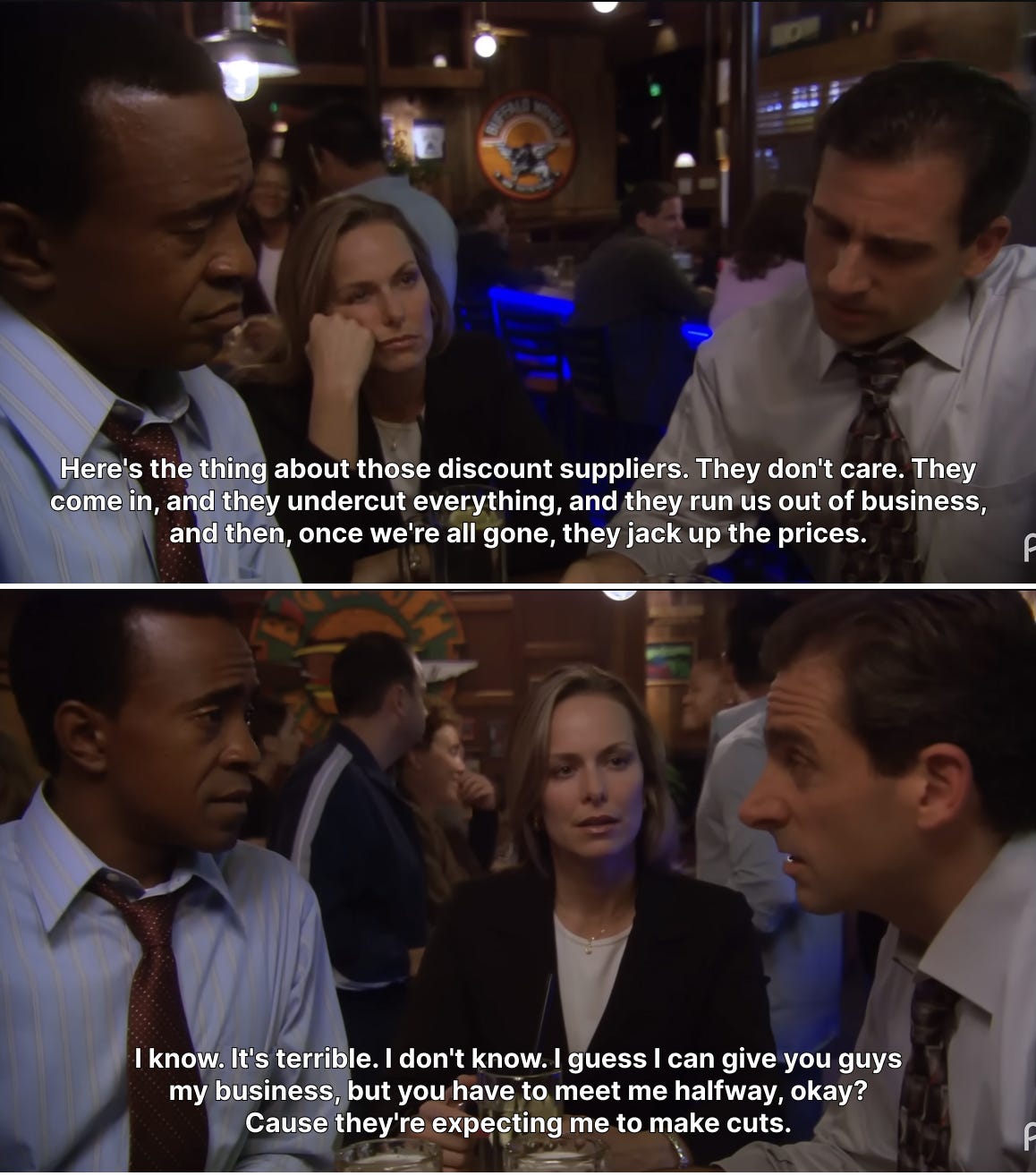
Above: Dunder Mifflin Regional Manager Michael Scott (right) and his boss Jan Levinson (middle) try to win over potential client Christian (left) by taking him out to Chili’s.
What Michael does in this deliciously written 5 min scene is really hard to pull off. Know your product, know your customer, know thyself - then chuck it, order the babyback babyback babyback ribs. It’s performance art when truly inhabited not just performed, not too different from 10pm in a dark room on the Lower East Side. You practice but once you go live you’re not thinking about mechanics, you’re reading the room, finding the rhythm.
There are genuine, life-giving ways to sell. You kinda just have to believe in yourself so hard, be so confident in what you bring that others (the right others, at least) can’t help want to share in your vision. The common maxim be more interested than interesting is not enough; at best you should be both interested and interesting.
And yet it’s hard to do both when contained in 200x300 pixels, no access to babybacks but instead squeezed in back to back boxes.
So as someone who works mostly remotely, I’ve turned towards taking meetings in person when I can. You can’t shortcut building trust. This is also why I can only do what I do in NYC - there are few other places where you can access such concentration of people, intent, signals.
For the last 8 years in NYC I’ve continually gone out to new places by myself; the past year was no different. The practice of developing relationships is always beginning, never ending. I bring a calling card if I have one (lately it’s been limited edition art prints), hand them out generously, judiciously, I might work with a recipient, I might never see them again. Make an impression, show up to the sample showroom in fidi, the basement, backyard, bar. Just show up as the type of person someone actually wants to work with.
Even as someone who can happily make conversation with a rock - no one sees the immense activation energy it takes. Sometimes life gets you down; this could be a whole nother essay. Nonetheless, I’ve found I can hit 15-20 activities a month across physical and digital motions. You can only trust the process if you’re measuring progress. Also measuring the qual as well as quants - I’ve written about tracking my learning velocity as a proxy for progress when the numbers are...less than inspiring.
It sounds like a lot but it’s not so bad when work is intertwined with your life (as it is for most indies). “Pipeline generating activity” may sound like an obtuse way to frame a coffee with a friend but usually those are recorded after the fact; sometimes work comes up in places I didn’t expect.
And I didn’t start with that kind of volume. The first half of the year saw 5-15 activities/month. My capacity has enlarged because my need for it has increased; is that not a miracle?
Making complicated things simple (On consulting style)
A brief intro: I help frontier tech founders with narrative strategy.
It took a year to develop my one-liner because every client is a step-wise move; each working engagement helps you confirm or invalidate a keyword in the phrase, while never straying from the core principle: I help make complicated things seem simple.
But that’s only the subject of my work; it’s harder to describe the way I work.
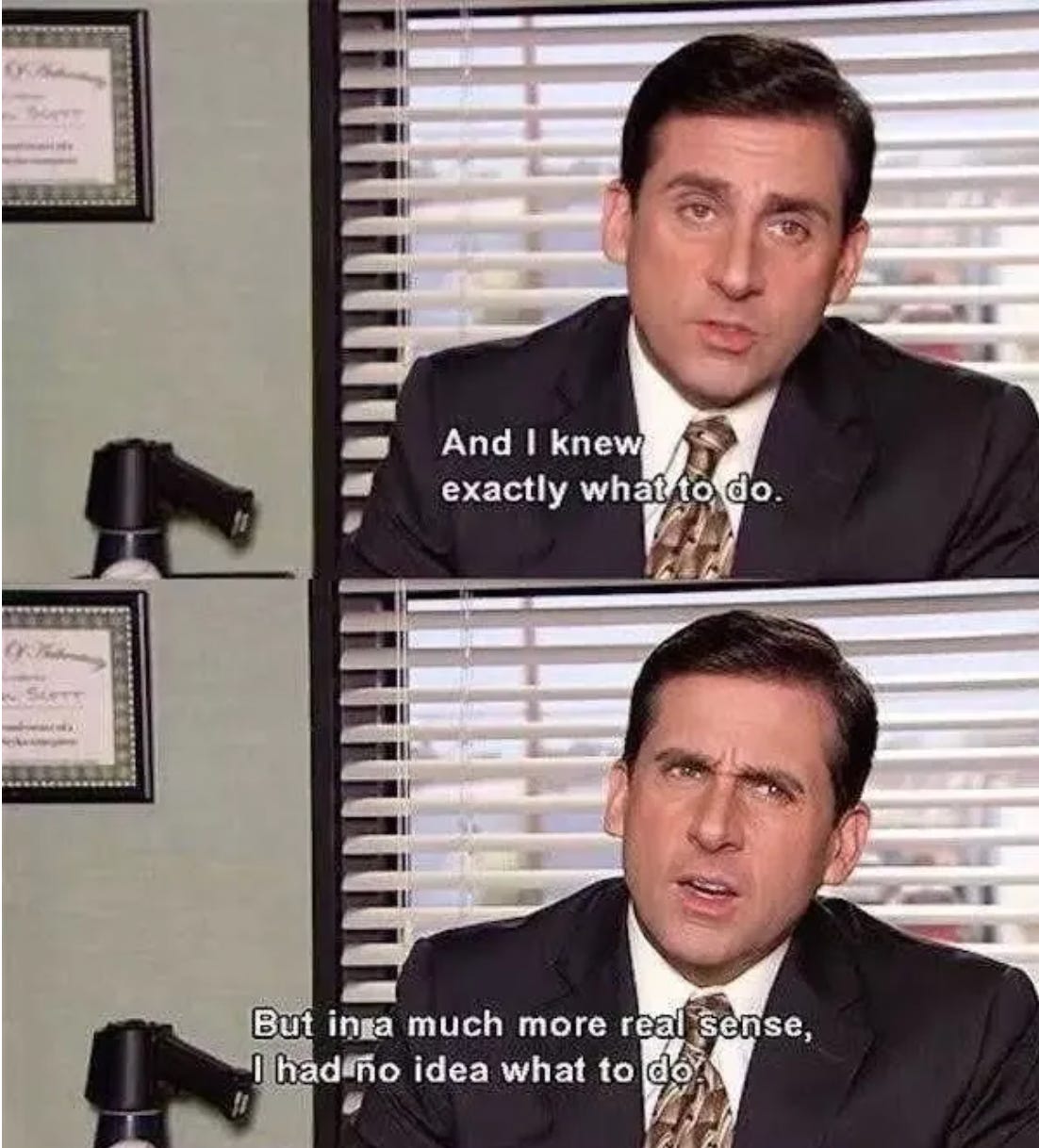
I thank people like Vaughn for how he talks about amorphous consulting:
Unlike the concrete consultant, the amorphous consultant doesn’t begin as a clear expert in what the client already knows it needs. Figuring those needs out is...a prolonged, failure-prone, and irritating learning process, but it’s a feature not a bug.
This is where the amorphous consultant’s value lies. Noticing what insiders can’t see and asking good questions is the only way to reveal otherwise invisible problems and opportunities.
I also relate to Anthropic’s Jack Lindsey on being hypothesis-free:
One of the central challenges for this research field...is we can go in as humans and say, oh, I bet the model has some representation of trains, or I bet it has some representation of love, but we’re just guessing. What we really want is a way to reveal what abstractions the model uses itself, rather than imposing our own conceptual framework on it.
And that’s kind of what our research methods are designed to do, is in a sort of hypothesis free as much as possible way, like bring to surface what all these concepts are that the model has in its head. And often we find that they’re kind of surprising to us. It might use abstractions that are a bit weird from a human perspective.
Promising projects usually start with clear conviction on outcomes and needs, a set of core deliverables, and then room for how the rest takes shape. Often something that goes like - We need cohesion and clarity in how we talk about ourselves. We need attention and traction. This is how AI at large has increased demand for my work - when emerging tech enables features and product at parity, story is the moat.
I’ve found the pricing model that works well - that honors the work and people involved - is when I bill for my time, not the perceived value of the work (e.g. monthly retainer instead of a set project cost) (I mean, this is how salaries work! Takes at least 6-12 months to see the value of your work regardless!). Especially with early stage companies, sometimes scoping a project can feel like an exercise in futility. Ongoing time-based containers design for both flexibility and boundaries.
If needed, I’ll approximate project cost based on a time-based model. Benchmark it with my full time market rate, now remember that’s also a number to take lightly - after all I cover my own taxes/insurance/benefits and I’m absorbing hiring risk on behalf of my clients.
With all the fraud and sprawl AI enables in the market, it feels...trickier, and frankly indelicate to try value-based pricing. I’m not interested in building a business off arbitrage and I’m happy to report I get nine hours of sleep a night.
Yet that’s half the work still, the harder part to assess is - I may be able to do the work, but are we the right partners for it?
Neurodiverse working environments are good, but they’re hard to cultivate. It’s good to have shared principles, less important are shared personalities or ways of thinking. And so I’m learning the value of unrushed discovery periods - taking the time to have early conversations that develop long term alignment, knowing that trust is cultivated through shared decision-making principles and rhythm as much as surface level warmth.
As how Joan Didion describes The Martha Stewart Way:
“There is an unusual bonding here, a proprietary intimacy that eludes conventional precepts of merchandising to go to the very heart of the enterprise, the brand, what Martha prefers to call the “presence”...”
Lose the magic, now find it again (On working with LLMs)
I don’t vibe code per se. Luckily it’s not my job to build customer-facing products but I do build in service of internal needs, meaning the stuff that you can never get prioritized by product teams. I don’t ask for apps, I just think through things with Claude, and Claude happens to code artifacts as a natural expansion of our thinking. Like a machine that thinks in words, farts in apps.
Essentially I use LLMs for communicating, especially with execs who need info-dense artifacts. The stakes are low since the goal is to make a decision not ship an update; no animals tested, no customers offended, no last mile problem.
I’m no longer limited to using just docs or decks or whiteboards to drive discussion. Now I can use interactive one-pagers or mini apps to workshop a roadmap, present analysis and takeaways, run a branding workshop.
“A writer tries to convey all the shifting moods, emotions, and tides within, but like the music, the full complexity of this thinking lives beyond the narrative grasp.”
—Ta Nehisi-Coates, We Were Eight Years in Power
Backend complexity does help with frontend simplicity. I’m just looking for an artifact for easy digestion, alignment, decision. Game, set, match.
Or if I was still in brand management for a scaling team - I could train an app to be a tone of voice editor for our teams, no need for the 10k starter kit from yet another AI copywriting company. An idea I had 1.5 years ago - aware that it was near impossible to get already stressed and pressed eng resources for that - now possible.
Of course LLMs are not a silver bullet. Sometimes they’re not effective in the ways I expect, and an artifact merely stands as proof of thinking. Ironically proof that I, me, human cared enough to try something out. Sometimes the output is indeed impressive, I sit there a little surprised. Did I really just yeet it like that?
It took Picasso decades to learn to draw the perfect single-line portraits. Well it took me a decade to learn how to yeet it like that.
Also let’s not forget the AI sprawl -

Say you start thinking with GPT,
realize you need better search,
switch to Perplexity,
now input output into FigJam,
realize you need better thinking,
switch to Claude,
nix the initial presentation medium for this new artifact,
but wouldn’t it be nice to send something more personalized than a Claude link, even with all the precautions?
Claude tells you to heave it over to GitHub,
or even Netlify or Vercel,
psych (yeah I thought it was overkill too),
back to GitHub but the private repository won’t work either,
back to LoL GooGle bc you’re annoyed at Claude,
ask it how to delete the repository because there are not one but THREE settings areas,
this is the only way to learn yung grasshopper 🐸
When you go to an LLM you must understand this: You will proceed to lose the magic. Account for this.
And yet, according to Anthropic researcher Jack Lindsey: “The model is spooky.” There is another definition of magic that can still help us, that we are in constant negotiation with. Lose, win, tie, repeat.
Beauty persists (On support)
A big thanks to the Secret Granola Club, my classroom’s worth of patrons via the newsletter. To my understanding - you support me not for the perks, but because you simply believe in my work. You support because this is beautiful before it is useful.
That is a gift for me - a flotation device too, when it gets extra hard to swim - and that sense of abundance inspires me to give in return. Small batch art, mailed out quarterly. Here’s the digital bookshelf of what supporters have received in the past couple years.
Aside from the business - the past years have also felt like collecting material for the sitcom that I won’t write. The internet doesn’t need my silent screams; in fact analog art might just be the best way to honor them.
“…I’d got the relationship between death and garden all wrong. I’d somehow internalised the idea that a good garden is a deathless garden, in a state of continuous perfection, even as I’d rejected the notion of it as a sealed sanctuary, a refuge from the outside world, with its plagues and wars. But neither of those things were possible. The garden was always engaged in a dance with death. It couldn’t possibly replicate Eden…It was as if my job was to maintain the visual illusion, as if the garden couldn’t possibly look good unless I’d succeeded in excising any evidence of death.”
—Olivia Laing, The Garden Against Time
In wonder
You stay in one place long enough, you are always revisiting your past self.
There’s a Think Coffee on Broadway that I walk past every so often. For my first job I worked in a company that moved to Soho at the tail end of my tenure, and that Think Coffee around the corner is where I told our president I was leaving. We had a good relationship; I remember that moment as bittersweet.
Do those moments even happen anymore? Do people still quit in person, have hard conversations in the flesh? Whatever happened to paying your respects to death?
Of course - thanks to those who have helped me pay respects to life. Thanks to Caitlyn, Pam, Jesse, Mamie, Ashley, Seren, Seref for your partnership. Emerline, Anna, Dave for your peership. Tom, Andrew, Kristoph for your practical wisdom. Kat, Lynn for your steadfastness. And my family, this is all only real because of your support and our weird wild genes.
This last paragraph I write sitting here in the suburbs of Dallas, listening to my niece practice piano. When she finishes she will run up to me and we will converse in Meow. In the meantime I am sitting here in wonder at who I’ve become.
“Sometimes when you’re writing, it’s almost like you don’t have to create anything. It’s all already there and the book is tapping into it. Or the book is like a machine that makes something happen in the world. It’s so exciting.”
—Elif Batuman