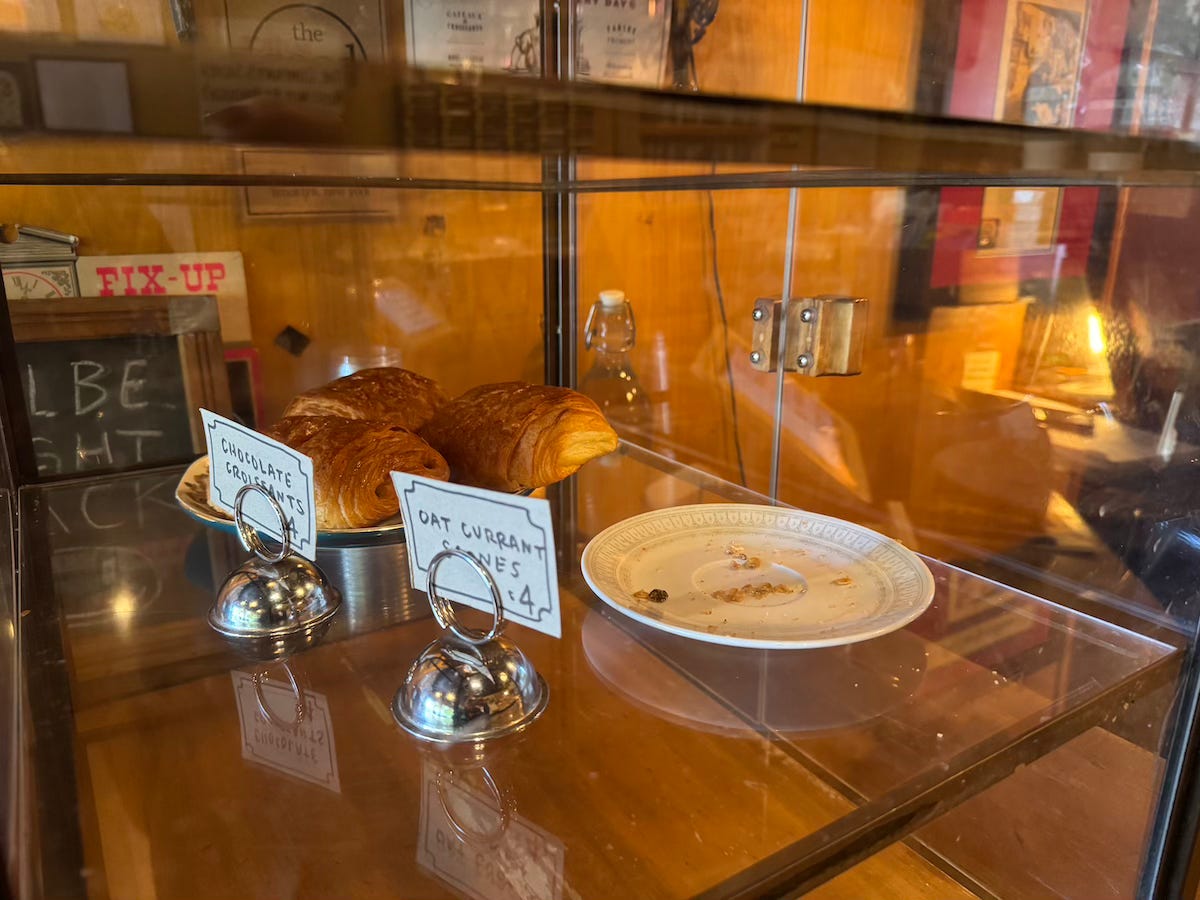
i promise you can afford imagination
In his commentary on Carmen Jones (1954), James Baldwin writes:
“For a second or so at a time [the character Miss Bailey] escapes the film’s deadly inertia and in [her] one catches glimpses of the imagination which might have exploded this movie into something worth seeing.
But this movie, more than any movie I can remember having seen, cannot afford, dare not risk, imagination.”
Because writing is hard we hand it over to the LLMs in hopes of escaping the deadly inertia come time to think, or god forbid articulate our thinks.
I do this too as a professional writer, assume I am still in control because I know how to recognize good writing - but really it cannot give me better than good comms structure.
Good corporate writing can also follow a formula, which is why LLM output feels like it could be good when in reality it churns out pop songs of content, earworm structures we are already attuned to hearing, it can even throw in a Max Martin certified offbeat. Nonwriters feel this familiarity even if they can’t make something better themselves.
Is that the premise, use the gpt since we can’t do it better?
I vomit at the question! Just as I vomit at output I myself have prompted, edited, shared.
The other day I synthesized my meeting notes and wrote my roadmap proposal without the LLMs, after telling the LLM I wasn’t going to use it. Excellent choice! it tells me. is it just the validation i’m looking for?
I asked GPT for questions to guide my thinking, it gave me too many questions but included a line on designing an “elegant roadmap,” I loved that phrase, asked Claude to define it for fun and it contorted itself around the question.
close the browser, pour yourself a forgotten pet nat, sit on the floor with your pen and paper


A couple hours later I had an elegant roadmap. Definition: Every letter earned its place, it was formulaic and a little wild like the sediment at the bottom of a pet net with no sulfites added, it was very Vicky. I may have trained my custom GPT on my personal IP but there are still secrets I keep close to the heart...
It was well received by the recipients too, and got me realizing - I don’t just rob my clients of the most valuable, most interesting parts of me when I use LLMs, but in reality since I’m my own business - I’m robbing myself.
LLMs are changing so fast but so do we. The art is in recalibrating through real time change across your variables, while defining and sticking to your unchanging principles.
It’s like that concept of - don’t skimp on investing in things that separate you from the floor, e.g. mattress, shoes, tires.
If this document is the only layer between me and a client, I can’t skimp. I can’t dishonor us both, not give the time of one glass of wine to the imagination which might have exploded this project into something worth seeing through.
Nothing worth having is linear right?
Trainer/Owner Asim Fayyaz of NOVA Barbell Club writes my gym workouts and he talks about patience with progress. Aka systematically building up tolerance to each variable of your system before adding in a new one.
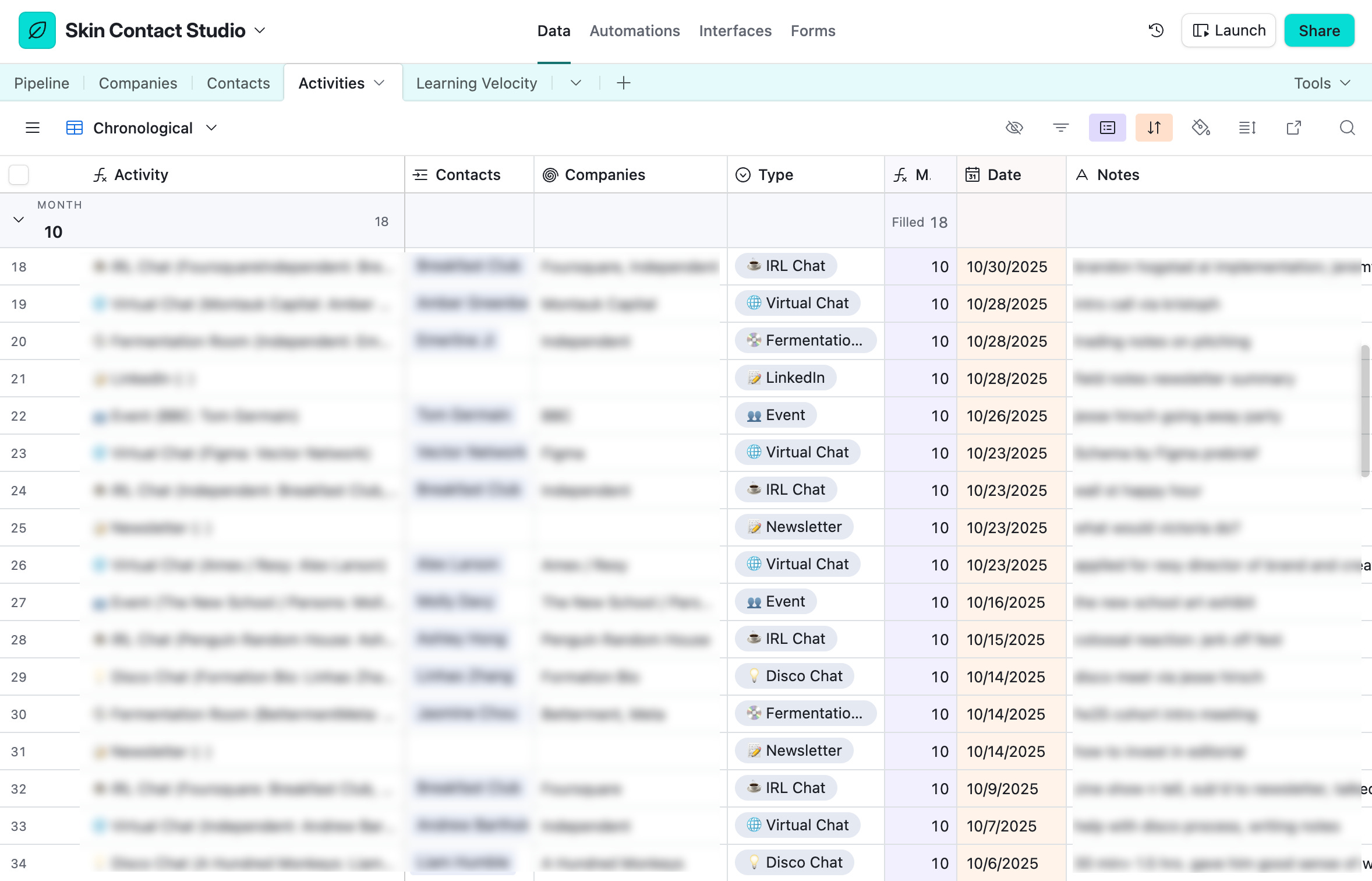
Applied to biz dev, my first task was defining my relationship-developing system to begin with. Bucketing out the types of interactions I was having and seeing everything through the lens of - what is its place in the system? The tone was always sincere, posture was always no expectations, but it still needed to flow back into the sheetz.
I tracked pipeline-generating activities for months, and that was enough for who I was then - the simple act of tracking helped with the accountability to fill the base, prove to myself that I was getting out there. Pretty straightforward:
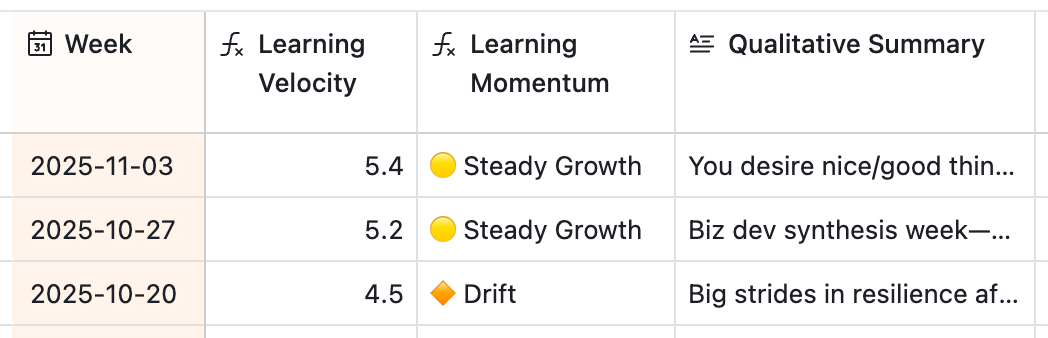
As time went on, something felt incomplete; even if pipeline wasn’t moving the way I wanted I knew there was progress to be accounted for. Time to add another variable! Learning velocity has entered the chat!
It’s a weighted average of my weekly quant + qual momentum. Tracking Activities as input KPI (a simple count, connected to Activities tab) and Learning Velocity as output KPI, 6 columns of me gauging:
How many domains & topical ecosystems I engaged in that week (long words but “industries” sounds so boring)
How many new insights I developed (my general proxy is - did the insight get externalized through something like the newsletter?)
How many times I transferred a learning from one domain to another (learning that the basis of my edge is being hyperdisciplinary)
How focused was my curiosity (scattered or pursuing targeted directions?)
How clear were my learnings (also correlated to the externalization bullet)
How integrated the learnings were (did it shift just my thinking or also my ways of working?)
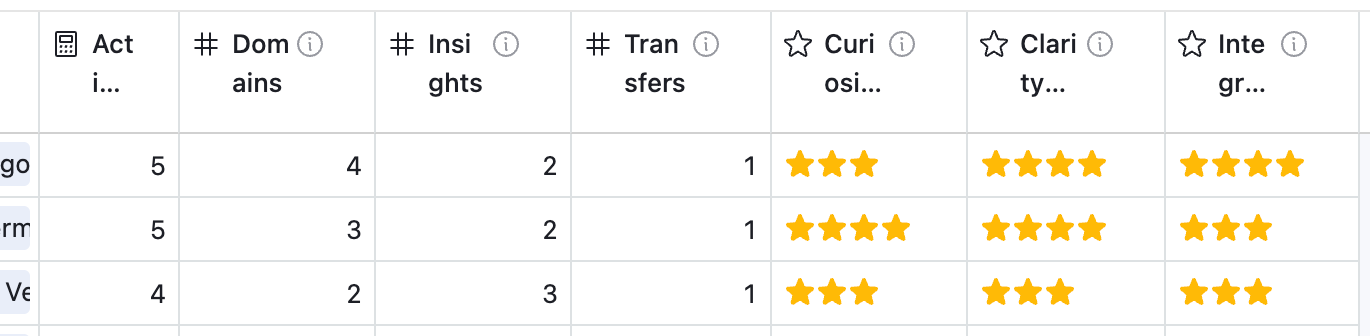
It might sound like a lot to think through but in practice it’s quick, just like logging a gut check. Then we visualize via interface, one chart of many.
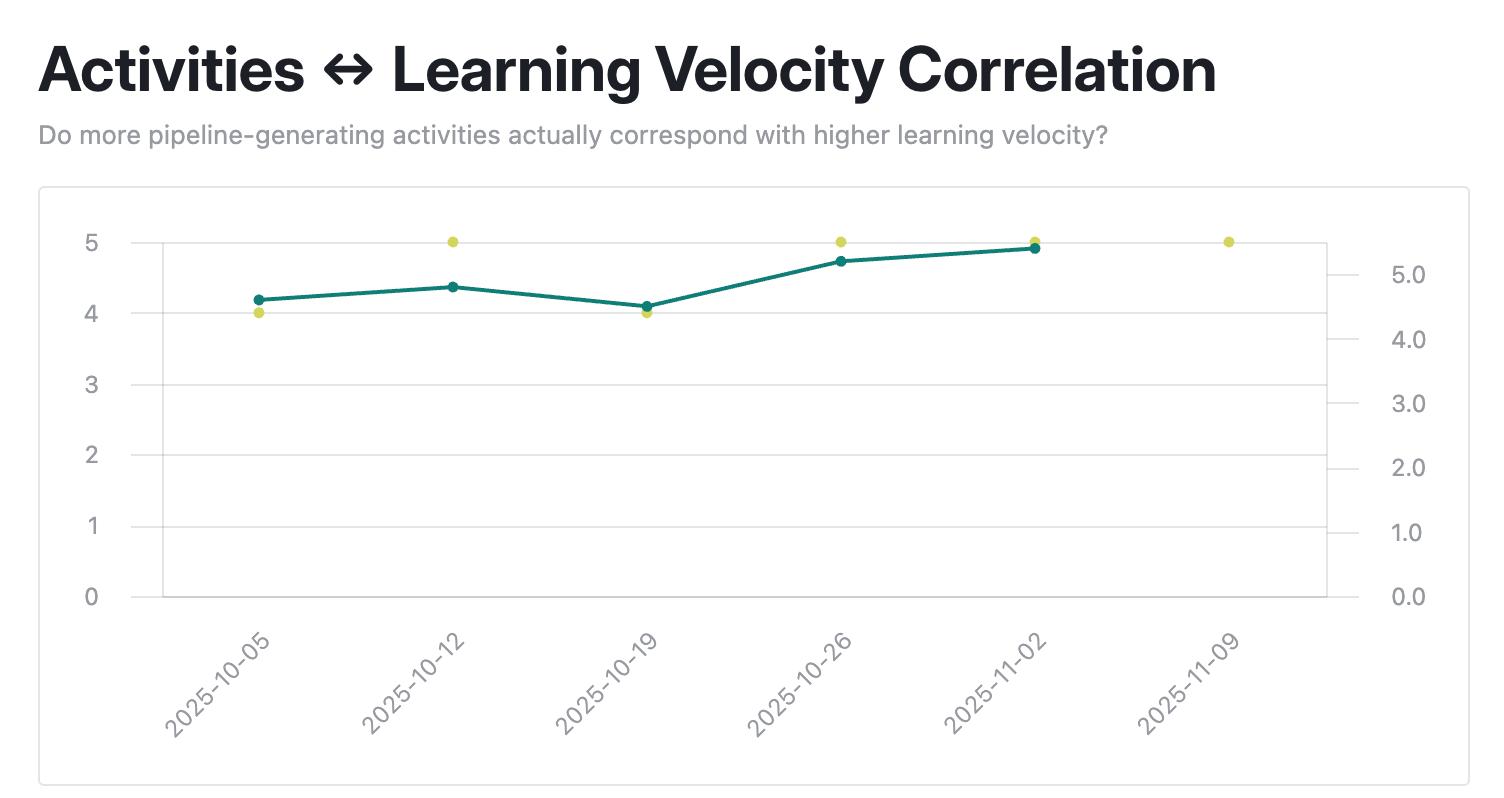
Asim says, “Marry yourself to the scatterplot over a course of days or weeks or months. Like look at the scatterplot, not the scale today. Nothing worth having is linear, right?”
No longer crying in Starbucks
I went down a mini Starbucks hole last week, triggered by Semafor’s Andrew Edgecliffe-Johnson:
If [newish CEO Brian] Niccol is feeling pressure from investors, he shows little sign of it.
Niccol turned his analysis about the company’s lost sense of direction into a strategy he dubbed “Back to Starbucks,” whose crisp branding he contrasts with his predecessor’s plan, “Triple Shot Reinvention with Two Pumps.” (“I don’t know what that means,” he says.)
Back to Starbucks is shorthand for returning the business to its community coffee house beginnings, with more inviting stores and a less complex menu. It speaks to Niccol’s desire to clarify what the company needs to do through simple, memorable messaging.
“The one thing that I’m most proud of to date is all of our stores know the Back to Starbucks strategy,” he says. “It’s hard to put a price tag on that clarity all the way through the organization.” (emphasis mine! viva internal comms! <3)
In other news, the bubble tea freak in me is also curious to see that the bux is “selling control of its operations in China to Boyu Capital in a deal that values the business at $4 billion - one of the largest divestments of a China unit by a global consumer company in recent years.”
Niccol says, “A lot of these competitors right now are only focused on convenience and flavor. We’re going to be able, I think, to out-innovate them on flavor. We can definitely match them on digital. And then we can have a real point of difference on experience,” he says. Where today’s Starbucks menu leans heavily on caramel, vanilla, and chocolate flavors, he sees opportunities to add more banana, coconut, and orange.
I wonder how much time Niccol has spent in China, walking through otherworldly mazes of drink stalls in underground malls, because I can’t see how the flavor part will work out.
As I wrote of Chinese bubble tea companies in America - their (so far) winning strategy is not selling to native Americans, but catering to the diaspora of Chinese money and taste.
Starbucks may have introduced Western coffee culture to China but the local tea brands are out-innovating and the local coffee brands are out-optimizing them. (Rivals like Luckin and Cotti now offer lattes for 9.9 yuan ($1.40) - less than a third of Starbucks’ prices. I barely drink coffee in China because the tea is too good, too interesting. The bux’s market share in China has dropped 20% in the past 5 years.)
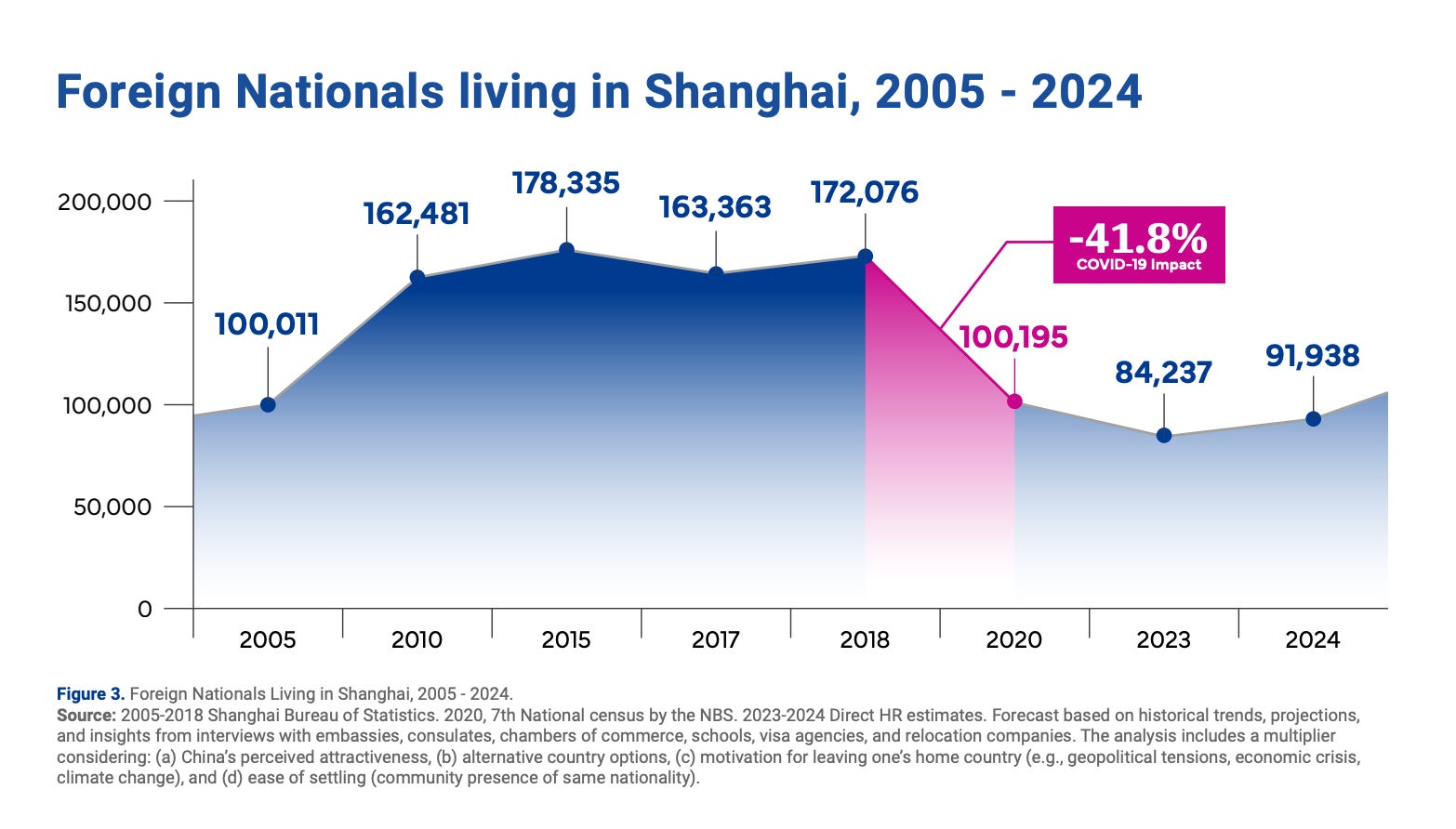
They also lack the inverse diaspora of Western money and taste in China. I mean, walk around Shanghai and you don’t need a chart to see that foreigners are at their lowest levels in 20 years:
And yet China is the only place I have a meaningful relationship with Starbucks, namely as it was where my baby college self stopped on my morning commute to my summer internship at Bank of Beijing, have myself a little cry and a $6 cold brew back when $6 was expensive for a coffee, then walk into the work cafeteria for breakfast pt ii, pork bun washed down with soymilk before elevatoring upstairs to a strange and fascinating work world with only intranet access.
In China it could’ve been the originator of my hit memoir, Crying in Starbucks. But back in Brooklyn I cannot escape America and I have two options within walking distance for my New Orleans cold brew, no nostalgia needed.
I have not only my nola but a place where I am greeted by name, the secret watering hole where the guys behind the counter stick around and the famous pizzaiolo smokes outside and calls his lover on speakerphone, where boundary lines fall in pleasant places and formers and yet-to-be’s walk alike, together watch the old man wander by, number his days knowing you will see him again, darkness too shall fall again, see how gently
Darkness comes next // See / how gently
Adam Zagajewski, “In Drohobycz”