

Hello subscribers old and new — today we have — my FW2025 zine release, deeptech commercialization, becoming an indie operator, smiling through the pain. It all belongs.


Hello 1050 pieces of paper Printed! Cut! Assembled! Bound! A mix of Chinese calligraphy, photos from gentle scorching Oaxaca, and the words that gently vomited out of the margins of the past year. I wish I had more energy for art but we will choose to be satisfied. I’m keeping the contents offline; the preface goes:
Already a year since my last zine Good Arson and yet the embers are still alive, argh! I thought I had waited it out long enough, but maybe the truth is there are some things I will not let go until heaven comes again. The Portuguese call it saudade, the love that remains.
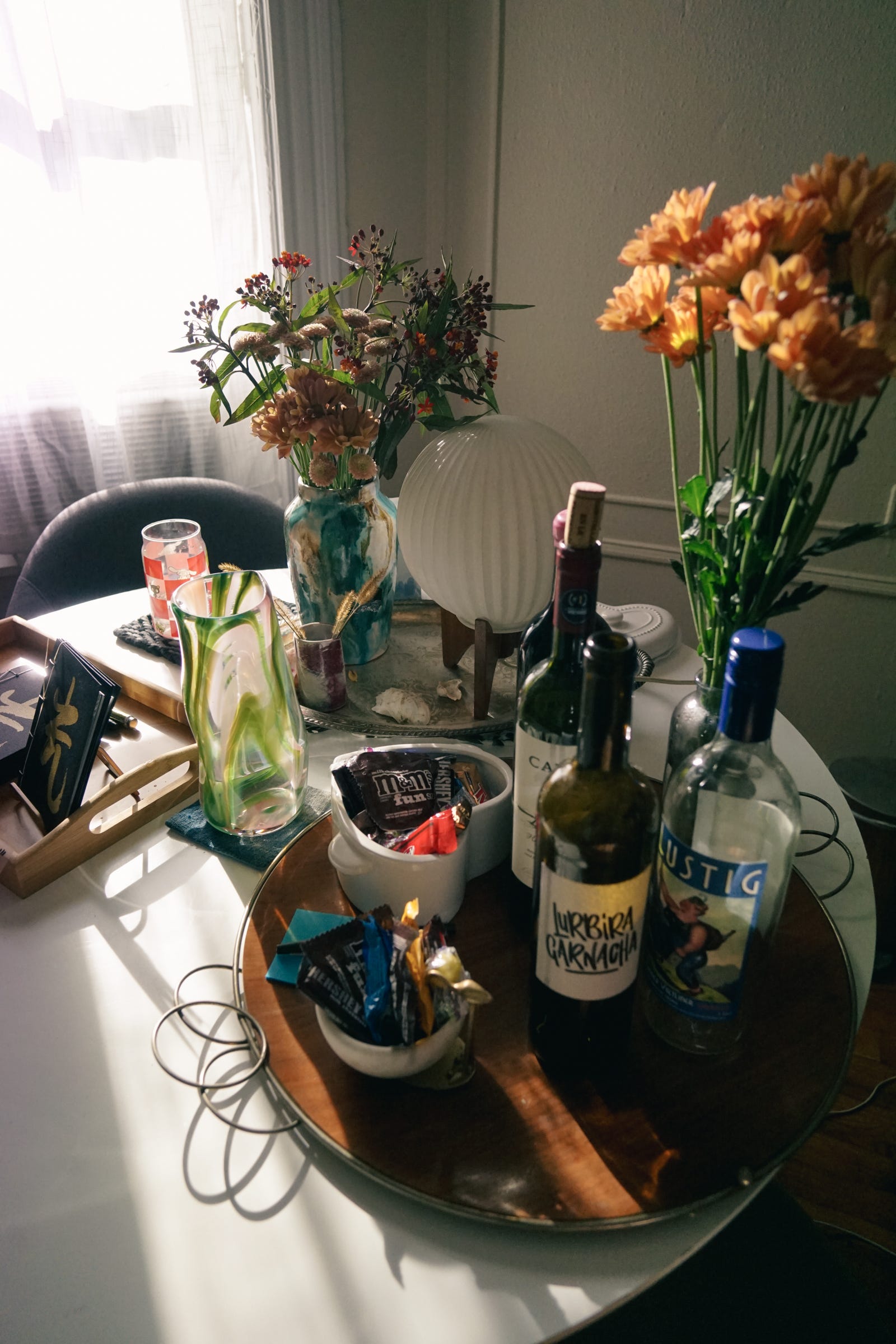
This year’s zine is a visual/verbal mixtape of what I call my waiting light, specifically what I survey in the early evening when the sun visits my living room through the trees outside the window, does its little crawldanceflicker across the walls of our storied little Brooklyn brownstone with the original crown molding. Eighteen months passed like this, me watching the shadows of an unfailing light. Watching until it is already the end of the year and yet this place feels like spring, a sunlight brilliance.*
—Vicky, October 2025
*Poet Bei DaoNote: The Chinese in gold reads 影不離光, which I’d translate to ‘shadows do not stray far from light.’ It’s bound right to left, ending on shadow (影) and starting with light (光).
Thanks:
Todd Allen Rutledge, Gowanus Print Lab
Marco Velasco Martinez, Espacio Pino Suárez
Pocoapoco (Oaxaca, Mexico)
Diego Pedraza
Chelsea Van Noord
Secret Granola Club members <3
Secret Granola Club members, I mailed these out to you last week so lmk if you haven’t received your copy yet.
Everyone else, I only have 7 out of 50 left, so if you want one — join the paid tier, or send me a one-time $15 and your address :)
Your product deserves a better story
Been talking to technical companies lately and finding words for a question I’ve been mulling on:
Does AI actually change the narrative for your company?
As an editor my gut immediately squawks no - but recent conversations have helped break down the logic.
AI doesn’t rewrite your story; it only expands the market in which your story now has to compete.
I’ve been in the headspace of biotech and pharma, energy and electrification, industrial engineering - the kinds of industries that used to be too R&D-heavy for mainstream venture/consumer attention. The infrastructure layers. High investment, high risk. Not the stuff investor dreams were made of.
But AI has derisked commercialization for deeptech. It’s compressing the path from hypothesis to drug, tightening grid efficiency, running multidimensional physics simulations, doing it all at new levels of speed, accuracy, and fidelity.
It’s wild that these are now my biz dev throughlines - far from my last indie season in 2020-2021 when I was talking to mostly consumer facing companies. But even if deep B2B’s entering its platforming era too, it deals with the same dynamics -
AI derisks the supply side of invention - through speed, cost, efficiency.
What’s still missing is derisking the demand side - belief, adoption, integration.
Derisking demand happens through narrative. Through having enough conviction that you don’t have to lead with “AI inside,” or “now we have greater TAM/SAM/SOM” (hardly trust-building outside your investor narrative).
You can accelerate invention, but you still have to educate the market. Define what you stand for to your teams, customers, and regulators - before the press decides their own spin on it. Translate intricate capability into a paragraph that people don’t have to read 3x to understand.
Even for market leaders where AI is the explicit product, they abstract away the technical aspects in their marketing campaigns. (See: ChatGPT & Claude ads.)
They try to embody the energy of a Black Panther 2 scene: Princess Shuri losing her mind while developing a drug to save her brother, iterating at 10x speed with her AI assistant, finally getting somewhere when she obtains the right source material.
Most websites are content overload, even the ones that don’t rely on conventional SaaS content strategy. Quick, generate some words to fill the empty boxes, it’s good enough no one’s reading anyways. This works until it doesn’t. Founder pedigree and handshake credibility only get you so far - and whether it kicks in at 10M or 10B, conversation is the new moat. Narrative IP is IP too.
In 1981, English artist and writer David Hockney and Stephen Spender visited China, where they got to talk to local guides about Chinese policies. Spender writes in their China Diary:
“...but I saw that I accepted too easily as truth the scientific arguments [for curbing population growth] and that in accepting scientific arguments one may be jettisoning the insight of the imagination into human nature.”
Science and imagination go together. No technical person wants a world where AI is the perceived differentiator to their work, just as no artist would.
If we’re gonna keep iterating on this thesis:
AI derisks production; story derisks adoption.
I’m always looking to talk with founders and VCs who are trying to hold both technical velocity and narrative integrity, or interested in what that could look like.
Who are trying to answer the question... how does AI help you translate capability into trust?
On becoming your own business
When you become your own business you are faced with the reality that it is now your job to answer the question - there are sooooo many measures of growth how do you pick which to track?
Obviously there is revenue, pipeline, etc etc. But how do you build the system that gets you there? Honor the invisible labor? Know you’re doing the right motions that enable you to trust the process?
I built out a new section of my CRM to note weekly pipeline-generating “Activities” as input KPI and “Learning Velocity” as output KPI (this is qualitative - my own gauge on synthesis quality). They’re on an Airtable scatterplot to track correlation over time.
What I didn’t expect was how building this system of metrics - and constraining the container - could keep me accountable to building a practice of reflection.
Also been formalizing my working principles, making tweaks every time I send them out - the current version:
I value early conversations that develop long term alignment, knowing that trust is cultivated through shared decision-making principles and rhythm as much as warmth.
I stay flexible, maintaining a posture of - “Let’s set this thing in motion and see where it goes.” As much as we can define an initial plan, the market might surprise us.
I seek to deeply understand the business and ecosystem before writing any words. I’ll do my own competitive research and ask for relevant data and insights.
On the note of supporting insights - I use evidence to increase founder confidence and bring grounded validation through moments of uncertainty.
I show work early and often until we hit a good stride, supported by check-ins with my main contact.
If you want to trade notes on personal ops/infrastructure, reply & lmk!
asdf
was the working heading for this section, which stands upon review.
we moved through a lot of territory today; the flip side of articulation is see the melted brain, human after all. the flip side is my head is an anvil between two loaves of wonder bread. (cue: paywall)